
Restaurant operations · Paid contract
Gyu-Kaku Portal
An internal operations platform for Gyu-Kaku Vancouver that replaces fragmented spreadsheet workflows with structured staff administration and constraint-based schedule generation.
- Role
- Solo Full-stack Developer
- Team
- 1 developer · 5 operational stakeholders
- Period
- Status
- Pilot in active use · Broader rollout planned for September 2026
Measured outcomes
- < 10 sec
- Initial schedule draft
- 6–10 hrs → ≤ 1 hr
- Weekly scheduling workload
- 90%+
- Reduction in availability-related human error
Generates the initial combined FOH and BOH schedule draft.
Includes approximately 20–30 minutes of manager review and manual adjustment after generation.
Context
Staff records, availability, vacation requests, schedules, and performance information were distributed across spreadsheets, email, and direct messages.
Managers manually copied and reconciled those sources while preparing separate FOH and BOH schedules.
Formatting shifts, misplaced rows, similar employee names, and separately communicated time restrictions could produce incorrect availability records.
Vacation requests were submitted by email and tracked separately, while blackout periods had to be announced and checked manually.
Staff had limited visibility into request status, time-specific availability, and changes to their role-based performance levels.
Users
- Gyu-Kaku Vancouver staff submitting availability and time-off requests, viewing published schedules, and following their role-based performance history.
- Managers and supervisors reviewing requests, maintaining staff records, configuring operational requirements, and preparing schedules.
- The pilot currently includes approximately 15 users, with about 30 expected during the initial rollout and capacity for future growth.
My responsibilities
- Product proposal and scope definition
- Stakeholder interviews and requirements gathering
- Information architecture and UI/UX design
- Frontend and backend development
- Database and authorization design
- Constraint-based scheduling engine
- Infrastructure and deployment
- Pilot testing and maintenance
- Documentation and staff training
Constraints
- Availability, approved vacation, roles, and time-specific working restrictions must be respected.
- A staff member cannot be assigned to overlapping shifts or receive an unauthorized double shift.
- Operational labels such as Closing must remain visible to staff while the solver uses estimated end times for conflict and workload calculations.
- Coverage, weekly-hour balance, fairness, and individual preferences should be optimized without bypassing eligibility rules.
- Managers must be able to adjust generation settings and edit the resulting draft before publication.
- A generated result must not overwrite a newer manual draft.
- Published schedules must preserve what staff saw at each publication point.
- The product and all public claims apply only to the authorized Gyu-Kaku Vancouver operation.
Implemented features
- Staff and manager authentication
- Role-based authorization
- Staff profile and employment record management
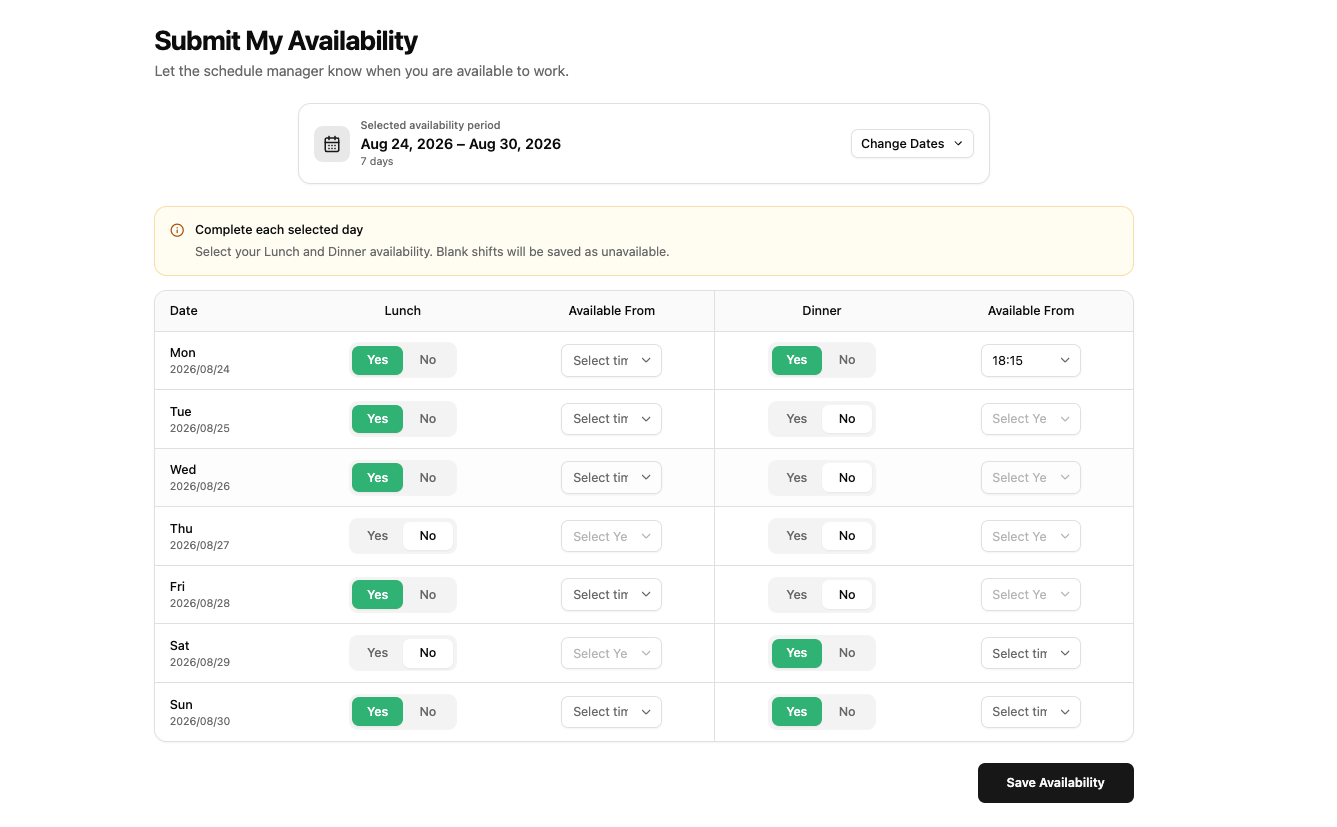
- Availability submission with 15-minute start-time restrictions
- Missing-availability tracking and manager review
- Vacation requests, approval history, and blackout periods
- Automatic exclusion of approved vacations from scheduling
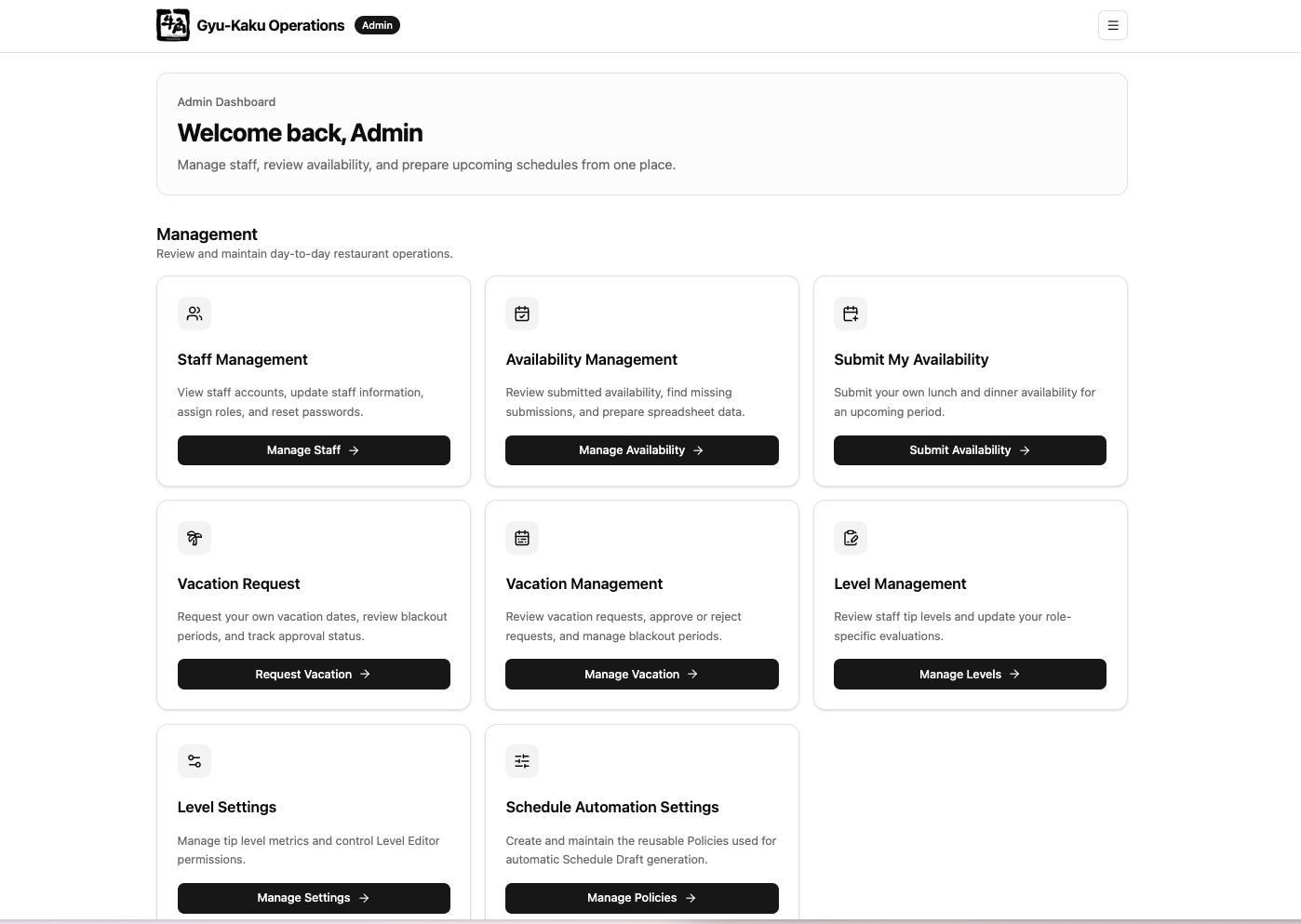
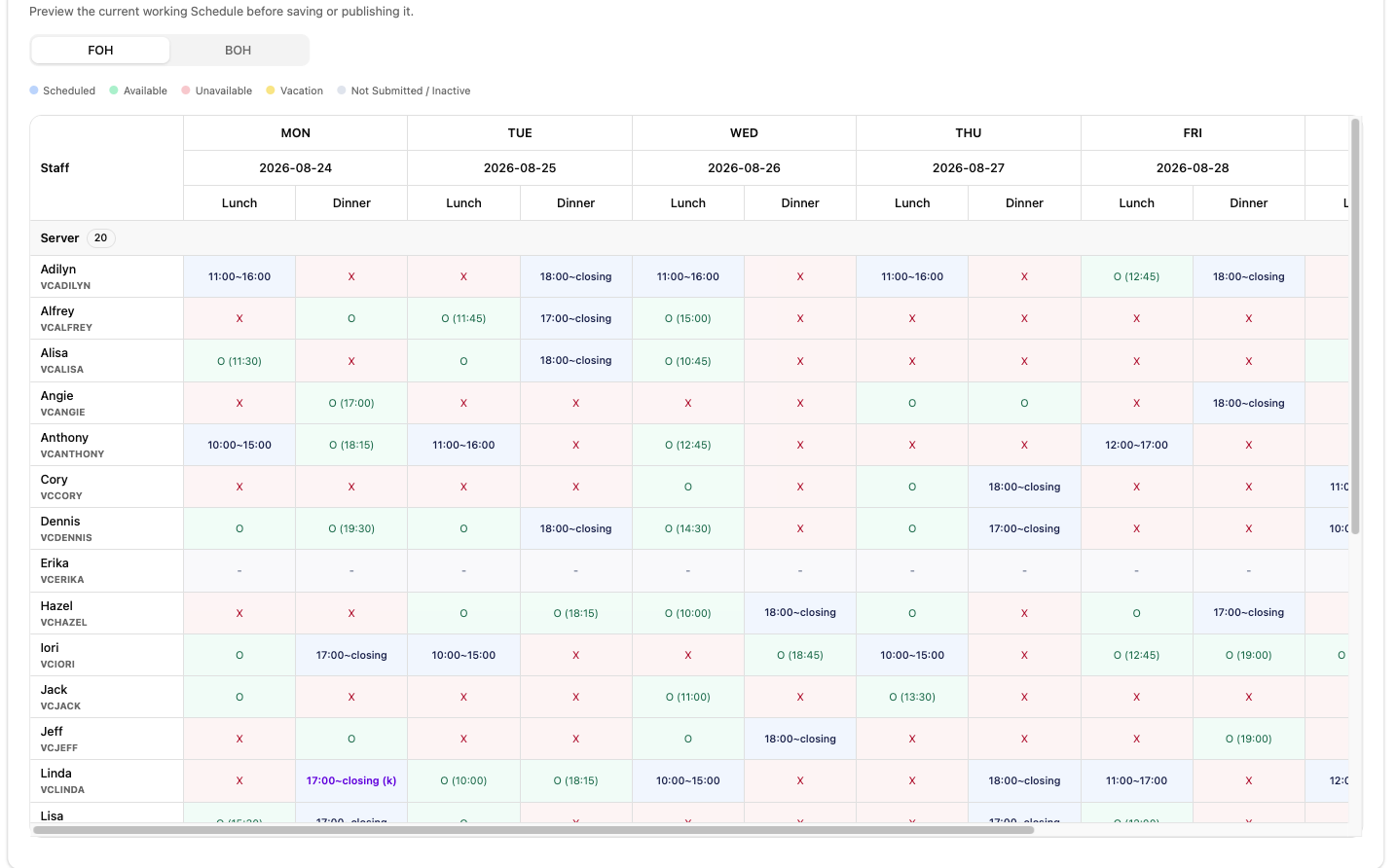
- Weekly FOH and BOH schedule management
- Google OR-Tools CP-SAT draft generation
- Configurable staffing targets and optional operational shifts
- Manual schedule editing and reassignment
- Scheduling conflict validation and override review
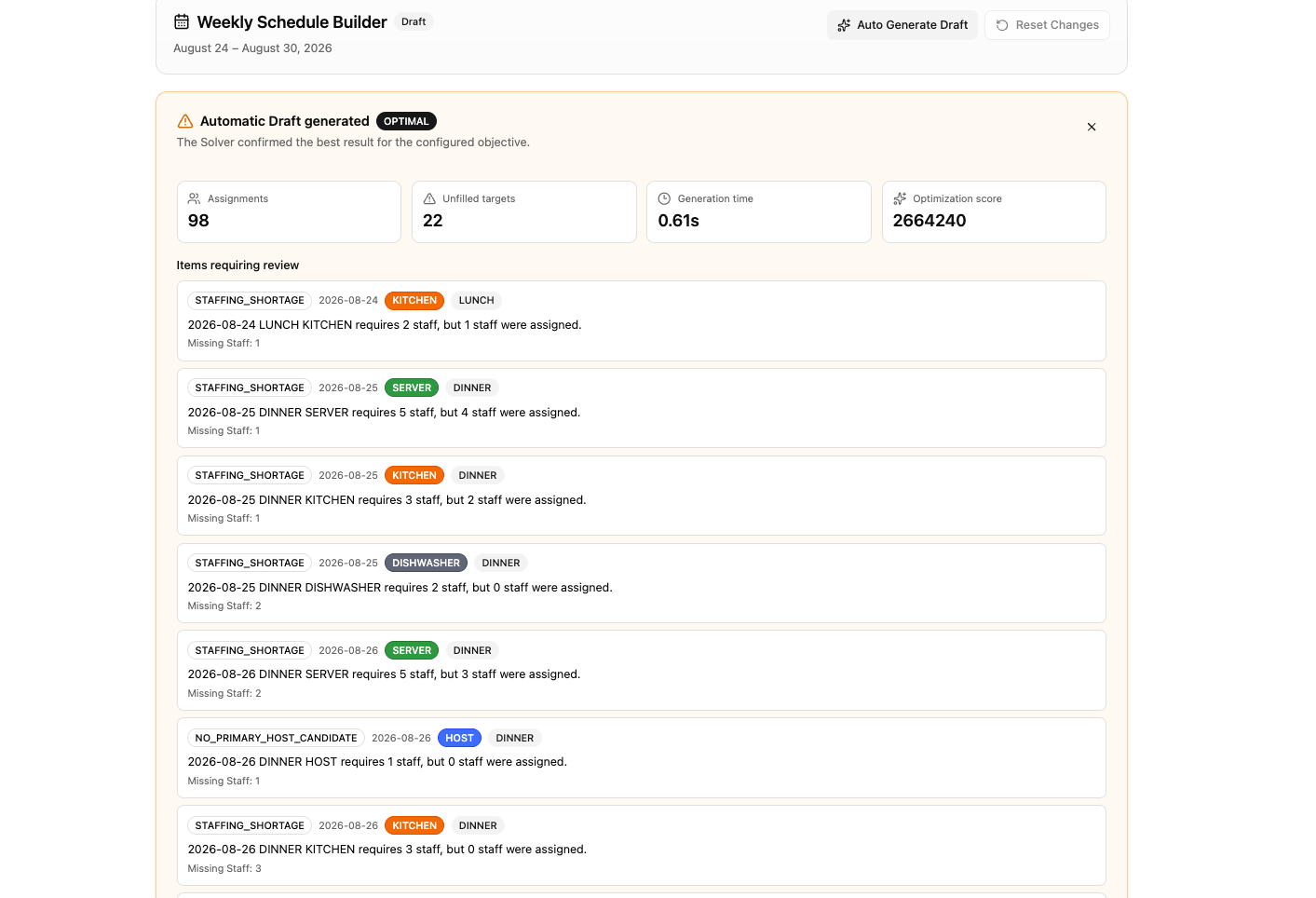
- Staffing-shortage and solver diagnostics
- Version-protected draft persistence
- Schedule publication and immutable published snapshots
- Staff-facing published schedule
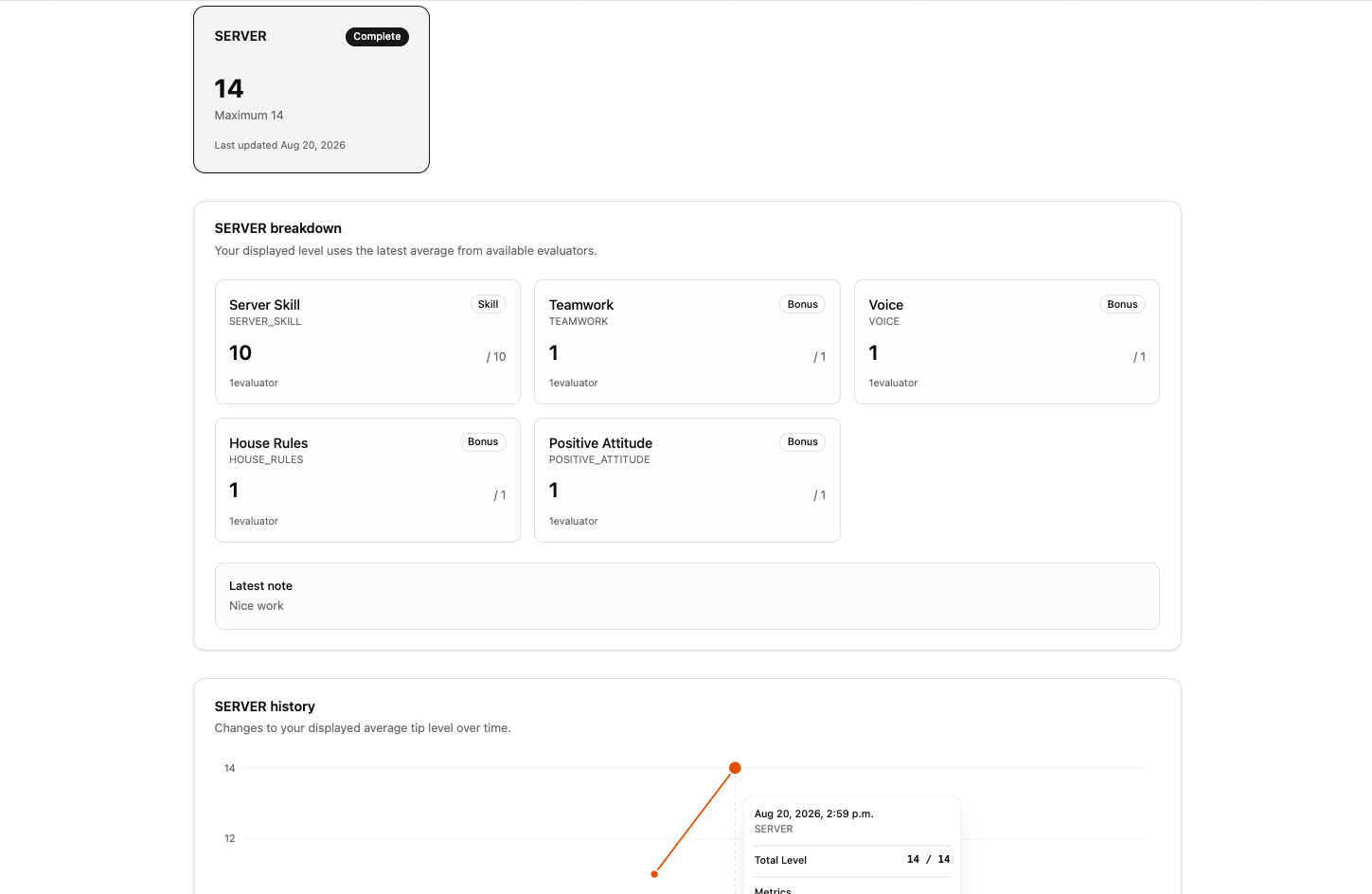
- Role-based performance ratings, history, and visual trends
- Responsive staff and manager interfaces
From fragmented coordination to shared operational data
The portal brings staff inputs, manager decisions, and published schedules into one traceable workflow.
Before
- Staff submit availability through shared spreadsheets.
- Time-specific restrictions are sent separately by message.
- Vacation requests and blackout periods are tracked through email and announcements.
- Managers manually reconcile the information before building FOH and BOH schedules.
With the portal
- Staff submit structured availability and start-time restrictions.
- Vacation requests, approvals, and blackout periods share one source of truth.
- Validated operational data becomes input for schedule generation.
- Managers review and edit the draft before publishing a preserved staff-facing schedule.
How a schedule becomes an editable draft
The solver is one part of a broader workflow that validates inputs, protects newer work, and reports incomplete coverage.
Operational inputs
Manager settings and staff-submitted operational data define the scheduling problem for a specific week.
- Staff records
- Roles
- Availability
- Approved vacation
- Daily settings
- Policy version
Candidate filtering
Invalid candidates are removed before optimization so the solver cannot fill coverage by breaking non-negotiable rules.
- Role eligibility
- Availability windows
- Vacation exclusion
- Overlap checks
Optimization
CP-SAT searches for the strongest valid draft while balancing coverage, hours, fairness, and operational preferences.
- Google OR-Tools
- CP-SAT
- Hard constraints
- Weighted objectives
Validation and diagnostics
The backend preserves valid assignments, reports coverage shortages, and prevents an older generation result from replacing newer manager edits.
- Shortage reporting
- Conflict validation
- Version checks
Manager-controlled output
Managers retain final control, review diagnostics, adjust assignments, and publish an immutable staff-facing schedule.
- Editable draft
- Manual reassignment
- Published snapshot
Hard rules and weighted objectives
The model distinguishes assignments that must never occur from operational goals that should be balanced.
Hard constraints
- Respect submitted availability and start-time restrictions.
- Exclude approved vacation dates.
- Assign only staff eligible for the required role.
- Prevent overlapping or unauthorized double shifts.
- Respect individual hard-hour limits.
Soft objectives
- Improve coverage across each role and service.
- Balance weekly hours and assignment fairness.
- Account for role and service preferences.
- Support busier days and optional operational coverage.
- Return the strongest valid partial draft when full coverage is impossible.
Technical decisions
Use a proven constraint solver
- Problem
- Scheduling required availability, vacation, role eligibility, overlapping shifts, weekly hours, coverage, and staff preferences to be evaluated together.
- Options considered
- — Keep schedule creation entirely manual
- — Add automated draft generation with an established constraint solver
- Decision
- Use Google OR-Tools CP-SAT to generate an initial schedule draft.
- Why
- Rather than building and validating a custom optimization engine, I used a mature, freely available solver and focused on accurately modeling the restaurant’s operational rules.
- Trade-offs
- — The quality of the output depends on accurate operational data and carefully modeled constraints.
- — Constraint and objective changes require representative schedule scenarios and regression testing.
- — Solver output still requires clear diagnostics and manager review.
Separate hard constraints from operational objectives
- Problem
- Treating every staffing preference as mandatory could make an entire week infeasible, while treating eligibility rules as preferences could create invalid assignments.
- Options considered
- — Require every staffing and preference rule to be satisfied
- — Use penalties for all rules and allow any rule to be violated
- — Separate non-negotiable eligibility rules from weighted operational objectives
- Decision
- Model availability, vacation, role eligibility, overlap, and individual hard-hour limits as hard constraints, while treating coverage, fairness, weekly-hour balance, and preferences as weighted objectives.
- Why
- The solver can produce the best valid partial draft when full coverage is impossible without assigning someone to a shift they cannot work.
- Trade-offs
- — A successful generation does not necessarily mean that every position is filled.
- — Managers must review shortage diagnostics before publishing.
- — Soft-rule weights can produce valid but operationally unsatisfying results if they are configured poorly.
Keep automatic output editable
- Problem
- Restaurant schedules are affected by situational judgment that may not be fully represented in an optimization model.
- Options considered
- — Publish the generated schedule automatically
- — Return multiple schedules for managers to compare
- — Insert one generated result into the existing editable draft workflow
- Decision
- Return an editable draft that passes the same validation as manually created assignments.
- Why
- Managers retain final control while the solver removes most of the repetitive assignment work.
- Trade-offs
- — The workflow is not completely automatic.
- — Manual edits still require conflict validation and explicit publication state.
- — The product must clearly distinguish generated assignments, saved drafts, and published schedules.
Report partial coverage instead of discarding valid work
- Problem
- Real staffing shortages can make full coverage impossible even when many valid assignments are available.
- Options considered
- — Fail the complete generation when one position cannot be filled
- — Relax employee eligibility rules
- — Save the valid portion and report the uncovered requirements
- Decision
- Generate the best valid partial draft and return diagnostics describing the affected date, service, role, target, assigned count, and shortage.
- Why
- Managers can continue from useful work without the system assigning unavailable or ineligible staff.
- Trade-offs
- — Managers must understand that a generated draft may still be incomplete.
- — The interface must distinguish staffing shortages from invalid policies and solver failures.
- — Candidate exclusion explanations can be improved further.
Separate displayed tasks from solver time estimates
- Problem
- Restaurant schedules use operational labels such as Closing, Break Cover, Helper, and Prep, but overlap and weekly workload calculations require a concrete time range.
- Options considered
- — Replace every operational label with a fixed displayed end time
- — Exclude task-based shifts from overlap and workload calculations
- — Preserve the displayed task while using a solver-only estimated end time
- Decision
- Store the operational label for the schedule and use role- and day-specific estimated end times only inside solver calculations.
- Why
- The schedule remains familiar to staff while the optimization model can detect conflicts, evaluate double shifts, and estimate weekly workload.
- Trade-offs
- — Estimated times must not be presented as confirmed working hours.
- — Role- and day-specific estimates require policy maintenance.
- — Workload calculations remain estimates for task-based shifts.
Protect manual work with optimistic concurrency
- Problem
- A manager can edit an existing draft while schedule generation is running, allowing a late solver result to overwrite newer manual work.
- Options considered
- — Always replace the current draft with the generated result
- — Prevent all editing while generation runs
- — Validate the draft version again before saving the result
- Decision
- Send the expected draft lock version with generation and reject the result if the draft changes before persistence.
- Why
- Managers can continue working without risking silent data loss from a stale generation result.
- Trade-offs
- — A rejected result may need to be generated again.
- — The client must present version conflicts clearly.
- — Draft mutations must consistently participate in version checks.
Connect operational workflows through one data source
- Problem
- Separate spreadsheets, email, and messages caused staff information, availability, vacation, schedules, and performance history to drift out of sync.
- Options considered
- — Improve the existing spreadsheet templates
- — Create separate tools for each workflow
- — Connect the workflows through one application and relational database
- Decision
- Use PostgreSQL as the shared data source for staff, requests, availability, schedules, publication history, and role-based performance records.
- Why
- Approved information can affect downstream workflows directly without being copied and checked again.
- Trade-offs
- — The application requires authentication, migrations, backups, deployment, and ongoing operational ownership.
- — Changes to connected workflows can affect several domains and require broader validation.
- — The private operational system requires careful demo-data and disclosure controls.
Outcome
- The complete agreed feature scope was implemented before the pilot and is currently in active use.
- The initial combined FOH and BOH schedule draft is generated in under ten seconds.
- Manager scheduling work decreased from approximately six to ten hours per week to no more than one hour, including review and adjustment.
- Availability-related human error decreased by approximately 90%, according to the Gyu-Kaku Vancouver management team.
- Staff can submit time-specific availability without sending a separate message to a manager.
- Vacation requests, blackout periods, approval status, and scheduling eligibility now share one workflow.
- Staff feedback indicated that role-based performance changes and their contributing metrics became easier to follow through the visual history.
- No major new workflow problem has been identified during the pilot so far.
- The broader Gyu-Kaku Vancouver rollout is planned for September 2026.
Reflection
The most important lesson was that optimization quality depends more on domain modeling than on the solver itself. I chose OR-Tools instead of building a custom scheduling algorithm so I could focus on translating real restaurant operations into reliable constraints, validation, and manager workflows.
Building the manual draft and publication lifecycle before automation proved valuable. The solver does not control the operation; it creates an editable starting point that managers can review and adjust.
I am particularly satisfied that the product serves both sides of the workplace. Managers gain a faster scheduling workflow, while staff can submit precise availability, manage vacation requests, view published schedules, and follow changes in their role-based performance levels.
If I rebuilt the scheduling architecture, I would persist each generation attempt with its policy version, daily inputs, solver status, objective breakdown, diagnostics, execution time, and resulting draft version.
I would also strengthen manager-facing explainability so the system could show not only where staffing is short, but why individual candidates were excluded.
The current synchronous execution remains appropriate because generation completes in under ten seconds. I would introduce background jobs only if scheduling volume or model complexity made synchronous requests unreliable.
Technology
- React
- React Router
- TypeScript
- Tailwind CSS
- FastAPI
- Python
- PostgreSQL
- SQLAlchemy
- Alembic
- Google OR-Tools
- Docker
- Nginx
Project links
- Private repository